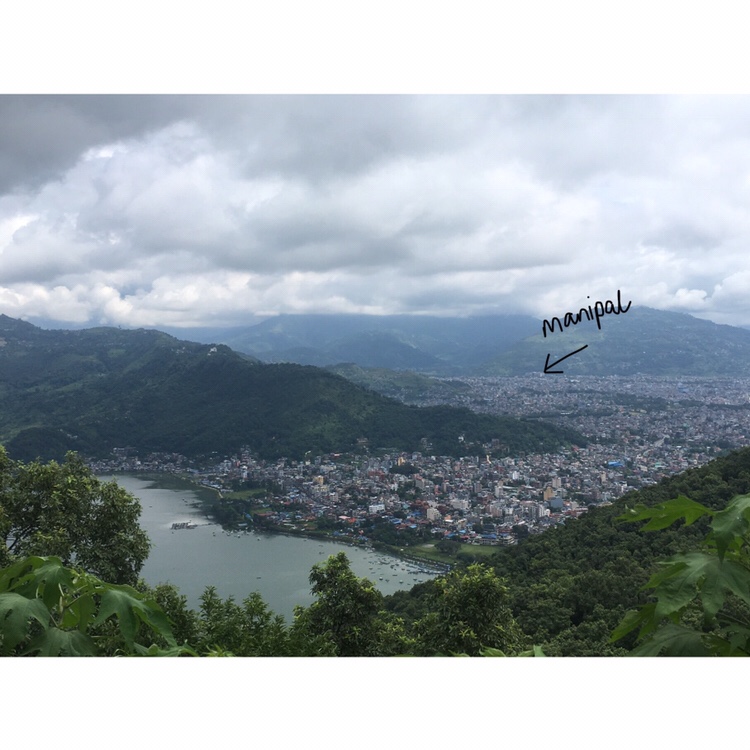
500 rupees (£3.30) later and I was on my way to Manipal Teaching Hospital which is on the other side of Pokhara, about a 25 minute taxi ride away. As we drove up the hill I had my first view of the prominent building that was easy to spot all the way from the World Peace Pagoda. It’s an enormous red and blue building, with hundreds of cars and motorbikes parked outside, and both police and guards at the entrance.
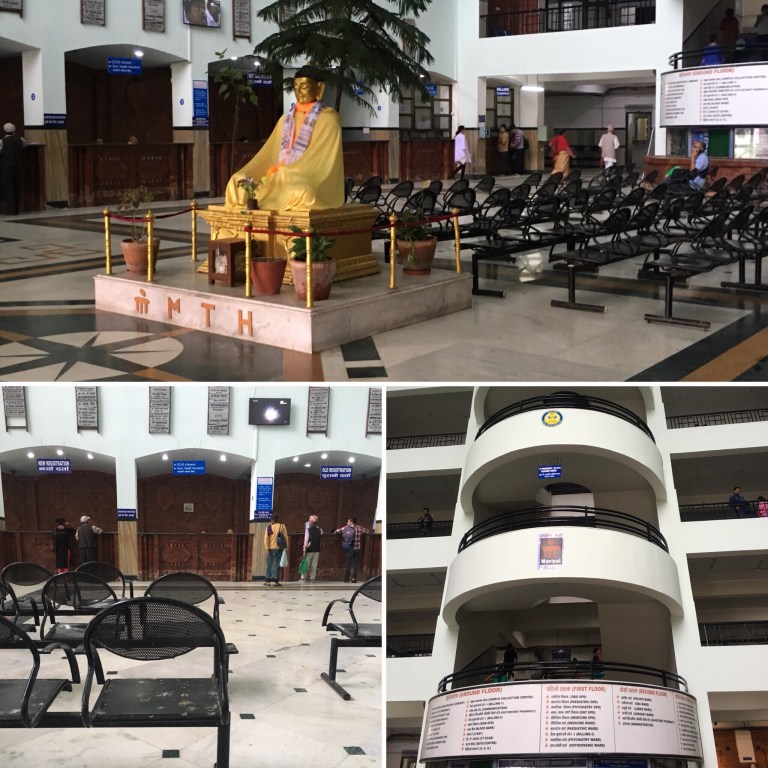
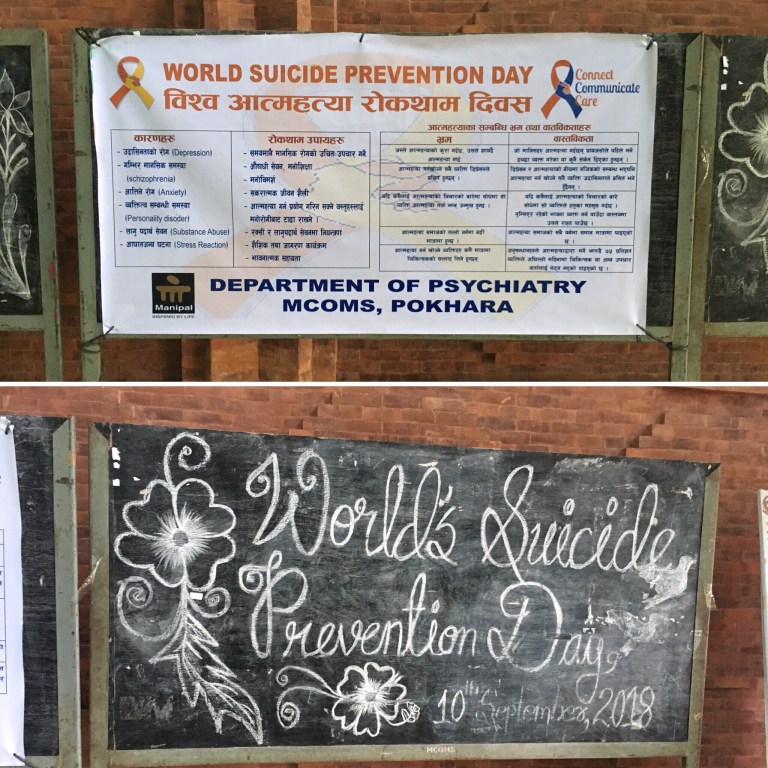
On first arrival, I was greeted by a large entrance hall which housed the three registration desks, the staircase to upper floors and a large statue of a gold Buddha. The hall reminded me of a train station, with metal seats in the middle where people were sat waiting to be seen. There was also two large signs about World Suicide Prevention Day which was yesterday.
I was 15 minutes early but decided to make my way up to the Managing Director’s office on the second floor. When I passed the first floor, there was a pharmacy with 20 or 30 people crowded around it, waiting for medication. On reaching the second floor, I asked a lady for help and she showed me to the office. I had been in contact with Dr. Singhi last week and requested a tour of the hospital and was due to meet him at 10am. On entering, he was accompanied by two colleagues but invited me to sit with them at his desk and offered me a hot drink. I waited until he was finished speaking and enjoyed my hot black coffee whilst I waited. It didn’t even look or taste like coffee, it was golden in colour and tasted like liquid honey; it was the nicest drink I’ve had in Nepal so far.
Dr. Singhi introduced himself and he was a very kind, helpful man. Whilst we sat there, many invoices and other paperwork were placed in front of him proving that he was a very busy man. When he got a chance, he asked me about my degree in the UK and what areas of the hospital I would like to see. I stated I would definitely like to see the radiology department and he told me he had already paired me with a radiologist who would explain the department to me.
We started our tour on the second floor which housed all the administrative offices as well as the private wards for people who wished to pay extra. Following this, he showed me the inpatients pharmacy which is where all the inpatients must pay and collet their prescriptions and then bring them back to the wards; a world away from the NHS!
On the first floor, the busy pharmacy I passed was still full with people and we continued on to the specimen collection point and path labs. On the ground floor was both the accident and emergency department and the radiology department. Dr. Singhi first introduced me to the consultant I’m A&E and explained that there’s 24 beds available for patients. Resus consisted of two beds and there were different zones for the degree of injury/ illness of the patient. The consultant in charge invited me to come back after my tour to see some of the work they do.
We carried on to the radiology department which was quite concise, with two X-ray rooms, one CT scanner and one MRI scanner. The current CT scanner had been removed and was being replaced by a new one as the current one had been in use for 10 years. They also had two ultrasound rooms and a mammography room.
The radiologist showed me around and then I got to see firsthand the radiographer x-raying the c-spine of a teenager, an elbow on a young boy and the chest of a lady. All the equipment is CR meaning that the cassette was used for both projections on the elbow and then processed in a machine. The radiologist explained that there is no Picture Archiving and Communications System (PACS) so all the images were printed and displayed like old X-ray films. The films are then given to the patient to present to their doctor. This was the same for CT I noted.
The cost of an X-ray was 100 rupees (66p) which is quite affordable for the people in Pokhara. The Managing Director explained that as it is a teaching hospital and most of the work is done by interns/ students, they can lower the rates, therefore benefiting both the patients and the students. I saw than an endoscopy examination cost approximately 1,200 rupees (£7.93) but they are now introducing government insurance which can cover medical costs up to 50,000 rupees.
After visiting radiology, I made my way back to A&E where the consultant was made aware that I was coming to observe. Apart from the consultant, there were three interns on, two of which had come to Nepal through World the World. I spoke to one Australian intern who had been there for 6 weeks and she was telling me the differences between Nepal and Australia.
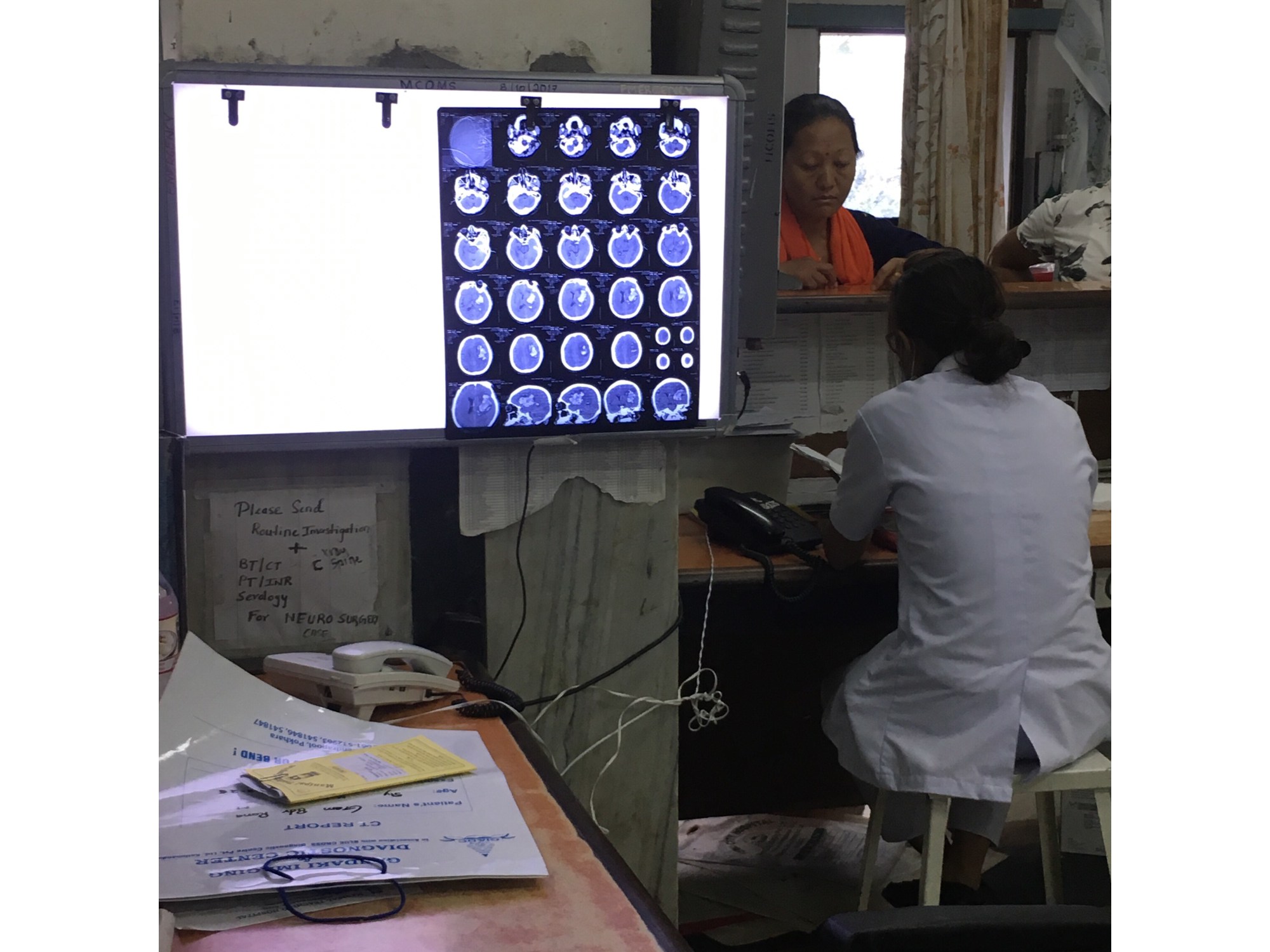
In the department, there were about five patients being tended to: the first had an intracerebral haemorrhage but had to go to the nearest hospital about 10 minutes away on blue lights as the CT scanner was being replaced at Manipal. He was waiting to be admitted to a ward. His CT was available to view at the desk as well as a previous patient’s imaging which is pictured below.
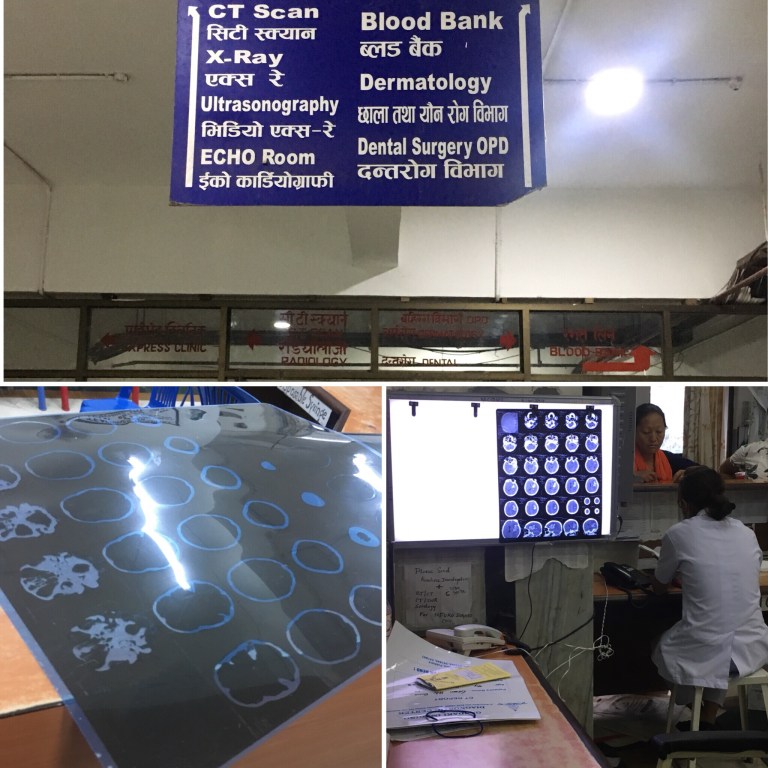
The second patient had a distended abdomen and faecal impaction so his bowels had to be manually evacuated. The third was suffering from liver cirrhosis and the third and fourth arrived just before I left and required ECGs.
The consultant and interns were very helpful and answered any questions I had. They were also quite keen to get involved with GVI to help volunteers have a better understanding of healthcare in Pokhara.
Overall I had a very positive experience of Manipal Teaching Hospital and would have liked to have had a few more days there but my time here is running out. Hopefully they can work with GVI to provide tours for volunteers especially the healthcare volunteers.
On the way back, I decided to take the local bus which was an experience in itself. I had to catch two buses which took an hour in total to return to Shanti Restaurant but only cost me 40 rupees (26p). The first bus I caught had a huge tyre in the aisle where women carrying children were trying to clamber whilst the bus pulled off. Each bus has a tout on who tries to gain custom by hanging out of the side shouting the destination. At the front of the bus, a passenger placed a large cardboard box which had air holes in and was squawking. I have no idea what was in there. The buses are absolutely packed to the brim but I can understand why as they are much cheaper than taxis for the locals. Half way I changed onto a second bus which brought me to lunch and we then had Conversation Club at 3pm.
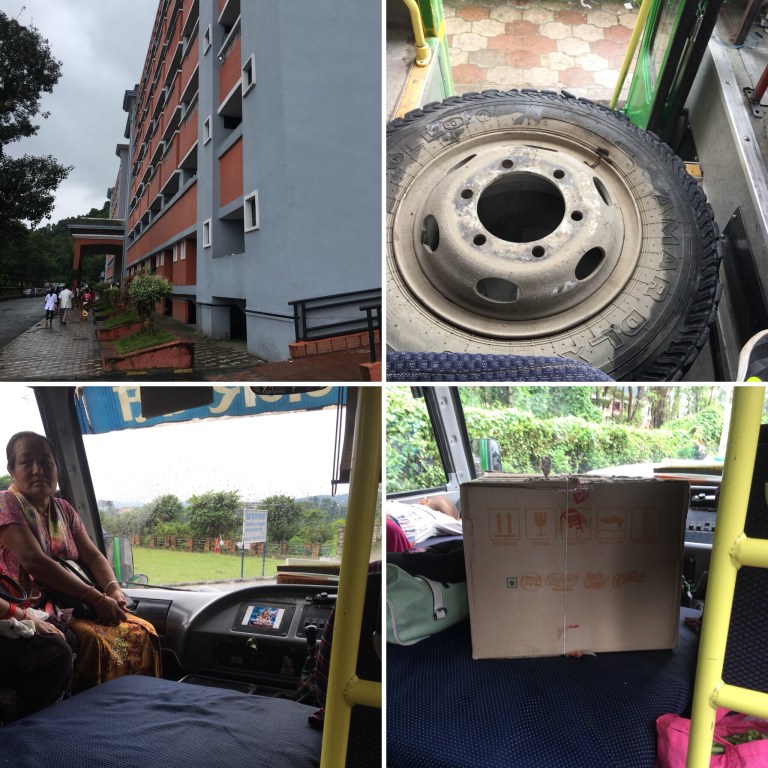
All in all a great day and I am grateful for the opportunity to visit this hospital and experience another side of healthcare.
If you have any questions, don’t hesitate to ask!
Jovi
* Trip sponsored by RTC Medical Solutions and Bangor University *
 On A Shoestring
I hope you have chance to describe the differences in the practices in Pokhara from both Australia and the United Kingdom and which in your opinion is the best way of doing things and the reasons why, 50,000 Rupees is only £530 imagine if thats all people got covered for in the UK
LikeLiked by 1 person